Storing Dominion
Three generations of custom boxes
Although Dominion solves the main problem with collectible card games, it is still annoyingly collectible. The boxes it comes in don’t have room for sleeving the cards, so I’ve been making my own boxes.
Contents
2011: Generation one
800 cards. One box. Wood cut mostly with hand tools.
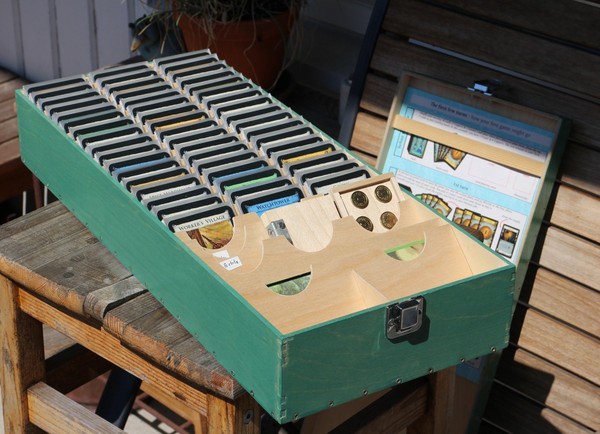
This solution lasted a long time because it was robust and it had the base game with my favourite expansion, Prosperity. That was enough to pull in casual players. The robustness comes from having 6 mm plywood sheets in the top and bottom, while the sides are 4 mm and the interior walls 3 mm.
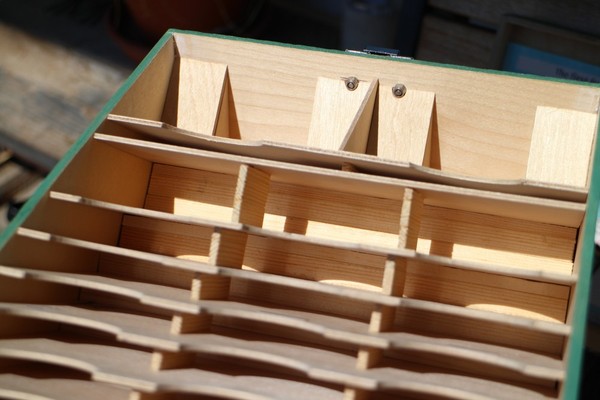
The main drawbacks of this solution were the lack of long-term variability and the awkward form factor. The box was too deep to fit anywhere, so when I stopped using it, I left the wood to be incinerated.
2022: Generation two
2450 cards. Two boxes. Laser-cut wooden exteriors, plastic interiors.
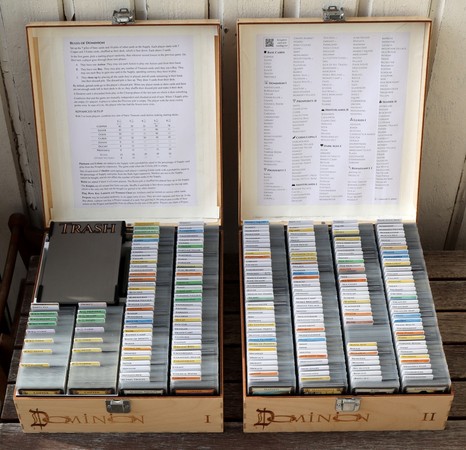
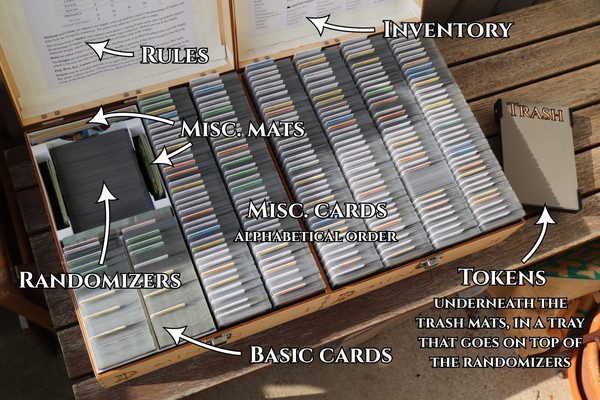
I like how neatly everything fit here, but that made further expansion difficult.
This solution solved all the problems of the previous one, but was not robust. The lids were on hinges and the rear corners were too weak for the force generated at these hinges in regular use, so I reinforced the corners after a couple of years. I should have used thicker stock from the beginning.
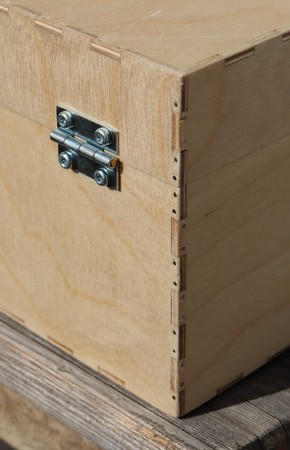
As of 2026, these boxes are still alive, but I gave them away. One is storing another player’s Dominion collection.
2025: Generation three
4500 cards. 16 boxes. Plastic.
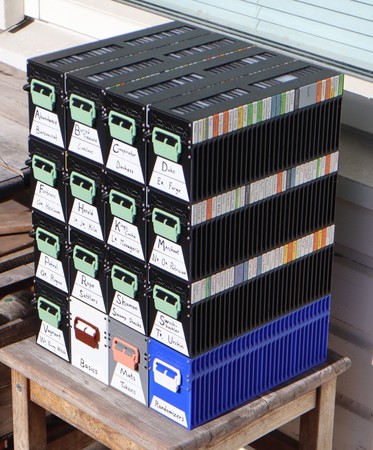
A more complex and compact design, where the joy of woodworking has been exchanged for the advantages of automation, modularity, and snugness.
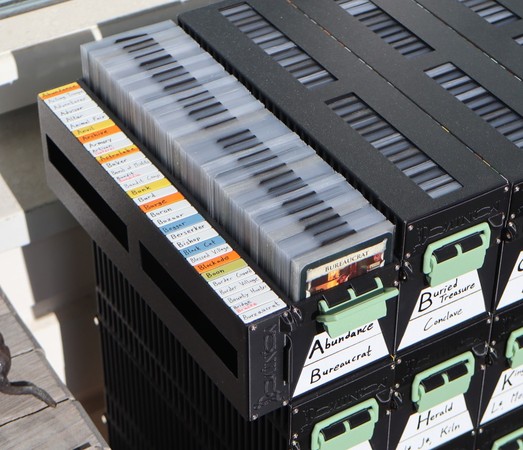
When a box is open, its lid attaches to the side of the box, with a pair of magnets that carry the weight of the lid. When a box is closed, different magnets secure printed latches for transport.
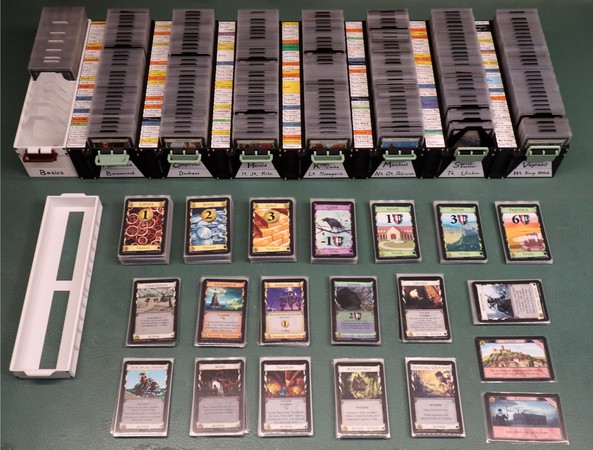
Part of the modularity comes from the fact that labels for card slots are all on little tracks, so they can be moved around for future expansions.

