The four Fs of Kingdom design
How to prepare a game of Dominion that players will enjoy
A fully randomized set of cards for Dominion is frequently boring to play, like a board game where the rules have been picked at random. There are four things that I always think about when I make a Kingdom, whether I start from a random seed or not. From most to least important, they are the four Fs of a fun game: Figuring it out, freedom of action, fairness in the first few turns, and finally, the flow of clock time.
Contents
Figuring out the non-obvious paths to victory
Design your Kingdom so that each player can work out at least one non-obvious and effective way to get ahead. What is obvious will vary from player to player. For example, first-time players are often surprised that you can Remodel a Gold to a Province for a late-game boost, but that takes only one card from the Kingdom. Consider this combination:
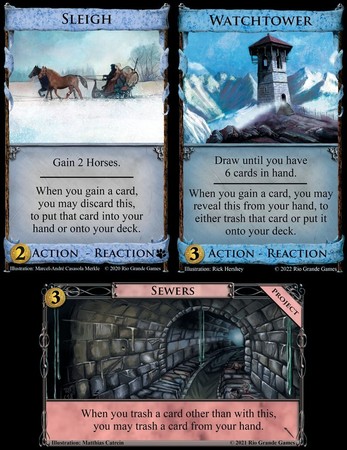
Sleigh, Watchtower, and Sewers.
Beginners quickly encounter Attacks like Witch that give you Curses or other bad cards, but let’s say this Kingdom doesn’t have any Attacks at all and no trashers apart from Watchtower. In such a Kingdom, a typical beginner will not understand why Sewers is there at all. An intermediate player will see that Watchtower is a reactive trasher that the player can trigger on their own turn without being attacked, but that is not always useful.
An attentive player will see that Sleigh with Sewers would trigger Watchtower, allowing you to trash up to two arbitrary cards from your hand, under the condition that Watchtower is in that hand and you are prepared to go without the incoming Horses. That play is counter-intuitive because Horses, like Gold, are valuable. All other things being equal, it would be better to trash an incoming Curse from an Attack than to trash a Horse coming from your own Sleigh, but it is only the net effects that matter. In this case, with the three components being cheap, the net effect will usually be positive and sometimes competitive. Remove Sleigh from the Kingdom, add a good source of Buy instead, and you can pull a similar trick by buying Curses for yourself and immediately trashing them. This will not guarantee victory, but it’s a meaningful plan of action that the individual player can discover and integrate in their strategy.
In the same way that players quickly evolve a desire to Remodel their Gold, they eventually learn to bet on trashing Horses they don’t even have yet. That process is a driver of the typical gamer’s interest in any board game, and it doesn’t have to be built on paradoxes like local self-harm. When you design a Kingdom, you design a new board game from prefabricated blocks. It is your main task to enable the genre’s joys, especially discovery and hope.
Freedom of action
Design your Kingdom so that every player will have the power to make interesting individual choices on their turn. Power, here, is mainly purchasing power, but it is also important to keep the Kingdom more competitive than the base cards alone. You start from an understanding of scale.
Designers are often tempted to build a “bigger”, more “epic” Kingdom. Perhaps they think that scale determines emotional investment and therefore drama, but Dominion is weakly themed and unsuitable for drama. Adding Colony and Platinum, for example, will often prolong the game and raise the final scores, but few players really enjoy these bigger games more. In general, if you want a big game, you should play something other than Dominion.
There is no player elimination in this game, but careless Kingdom design can lead to a game that is big in the sense of taking a long time to play: a slog where players can’t do much. If you include Mountebank or Marauder, with little or no defence or trashing, you cause a slog by posing the prisoner’s dilemma to the players. If you combine that with Colony and Platinum, the only joy at your disposal will be Schadenfreude, which is the joy of harming others. That is a trap that you, as a designer, must work to avoid. If you want to include Mountebank or Marauder, make sure that all players have a non-random ability to save themselves by something other than a rush.
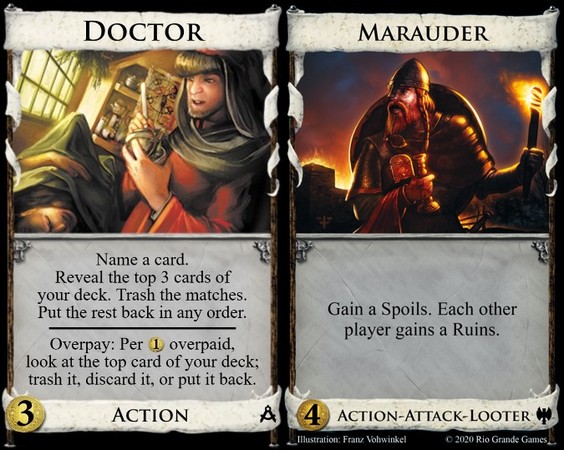
Nothing leads instantly to a slog, and not every trasher can pull you out of one. For example, Doctor is a bad choice to counter Marauder. That’s because Ruins come in several flavours. Playing Doctor only trashes one.
The rush strategy is the converse of the slog. When it’s a matter of player choice, a rush is typically more fun, but in the same way that you can make a slog natural through Kingdom design, you can make a rush natural and obvious. Consider a Kingdom that has Fool’s Gold, Search and City. Most likely, regardless of what else is on offer, enough players will try to maximize the benefits of these cards by getting a lot of them. This would have the side effect that the game ends quickly and with low scores. Like a slog, that game will have very little real freedom of action.
The pure Big Money strategy is one way out of a slog and can counter a rush. That makes it useful, but if you deliberately make Big Money competitive, your Kingdom is bad. Nobody prefers a game where Big Money is the easiest or safest path to victory.
Fairness in the first few turns
Design your Kingdom so that it has as much randomness as your players prefer. To do this, you should first consider that cards don’t have the same ratio of cost to benefit. For example, Chapel and Pearl Diver cost the same, but Chapel is almost always better for the buyer, especially in one of the first two turns.
It is a minor goal of Kingdom design not to leave two cards of such disparate value on the same tier of cost. That goal can be served in many ways, such as making Pearl Diver Cheap, or constructing non-obvious paths to victory where Pearl Diver and not Chapel combines with other cards such as Goons (buying for a benefit unrelated to cost, which is better with a cantrip like Pearl Diver) or Throne Room (which turns any cantrip into a metaphorical Village).
Problems of relative card strength are problems of fairness in Dominion, but mainly in the first two turns playing Kingdoms where the cost-to-benefit ratio is different for each tier of cost. Barring non-default starting conditions such as Heirlooms, you will either have 5 and 2 Copppers in your first two hands, or 4 and 3 Coppers. If your Kingdom has nothing at cost 5, or nothing at cost 4, that usually hurts the value of one of these starts.
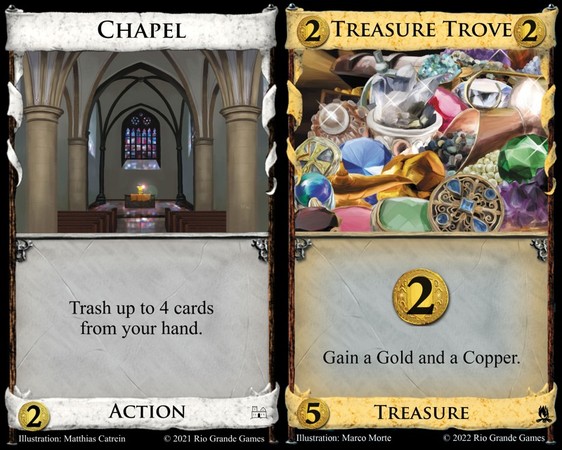
If all the 4–3 combos are weaker, then this strong 5–2 start with Treasure Trove threatens the fairness of the game.
For a player group that dislikes randomness, offer the building blocks of deck control. For a group that prefers a “gambling” play style, offer Hexes, Boons, Loot, obligate trashing after drawing, or other mechanics with an element of luck, but do still try to keep the possible starting hands balanced. A daredevil can take some comfort in the feeling that they’ve earned a bad result, but not a bad start.
The flow of clock time
Design your Kingdom so that a successful engine builder does not slow the game to a crawl. You do this not by controlling the amount of cards and actions a player can see in their turn, but by controlling the amount of new information they receive from their engine.
I’ve mentioned slogs and the pitfalls of trying to make the game “bigger”. Similar dangers lurk in the simplest engines. The combination of Village and Smithy builds what you might call a combustion engine, where the growth of the player’s hand is explosive and repeatable on an even cadence. That creates an incentive for the player to take up more clock time, drawing a bigger hand and playing more Actions. Assembling and using that engine also takes up Coins and Buys, but to players, the cost in clock time is special. Playing slowly is an economic externality that has no impact on your score, but it makes the game less fun for everyone else.
For the common good, it falls to the designer of the Kingdom to ensure that a slow engine is either not possible, not a path to victory, or not something you can run early and consistently. My favourite way to achieve this is to use a “limited Village” rather than a simple Village with at least +1 Card and +2 Actions. For example:
- Diplomat: The +Action flow stops if you have a large hand, which Diplomat threatens to give you.
- Snowy Village: The +Action flow stops immediately, limiting the range of the engine.
- Acting Troupe: This allows the same amount of subsequent Actions as Snowy Village, but consumes itself and draws nothing. Friendly to Throne Room.
- Sacrifice: A Village-like effect requires trashing another Action.
- Cursed Village: Just what it says on the tin.
With the right supporting drawers and enough cantrips, any of these limited Villages can play into a combustion engine, but it won’t be easy. If you use something even less like a Village, and avoid sifters, you get engines that are faster on the clock.
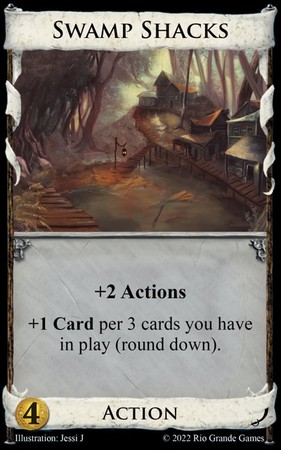
Swamp Shacks is double-edged. It’s bad at kickstarting an engine because it has no guaranteed draw, but it scales with the engine so that you need fewer steps, and therefore less clock time, to achieve control of a large deck.
Another design strategy I find interesting is to limit drawing during the player’s own turn, but let it happen at end of turn (Way of the Squirrel) or during other players’ turns (Lost City). This way, players have a chance to plan “off beat”. They don’t need to react to their cards in real time and will have a plan of action ready when they’re back on the clock. This is difficult to achieve because end-of-turn effects are rare, and communal drawing tends to come with personal drawing. Council Room can lead to a game that’s fast enough on the clock, but it also won’t have many turns.
Conclusion
It is not enough, in my opinion, to follow hard and fast rules of Kingdom design. You can ensure that every card has some synergy with another, you can offer a Reaction for every Attack, and you can distribute the cards evenly by their cost in Coin. That will usually give you a decent Kingdom, but you can achieve more with the fundamentals. A great game of Dominion is like any great little board game. It flows smoothly, with everyone learning clever new tricks instead of being left out with no real options. The “deepest”, most replayable Kingdoms have many paths to victory just waiting to be discovered. It is the knock-on, ecosystem interactions between these paths that doom a Kingdom, or save it.

