The board game Dominion
Fixing Magic since 2008
Dominion (USA, 2008/2016) is the first game in the genre of “deck-builders”. It combines a short play time with excellent replayability and configurable complexity.
Contents
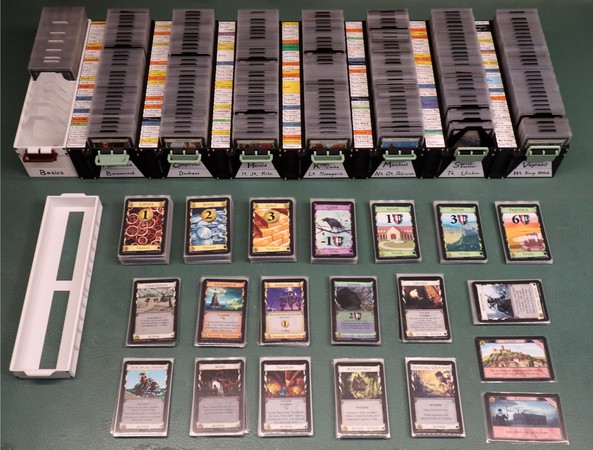
Ready for a game of Dominion. Only a fraction of the cards are brought out of their boxes.
Deck-building before the game or in it
Dominion is not a “collectible” card game like Magic: The Gathering (1993). In the classic way to play Magic, each player buys their own cards and builds a deck that they then bring to a game. Playing Magic proves who did better before the game began, but it doesn’t do much else. Dominion isn’t like that.
Self-interest in the deck-building or “pre-game” phase of Magic leads dedicated players to obsess over “the metagame”, “paying to win”, and speculation about how the opponent is building their own deck and how to “counter” that before you meet. All of this discourages casual, social players, without necessarily pleasing dedicated players.
In the same way that Games Workshop has come up with vulgar solutions to the similar paradox of wargame design, the makers of Magic have come up with vulgar solutions to their own design problems, such as having players build a deck on site from random cards, and adding characters from other media franchises.
Dominion’s solution is more elegant: Self-interest is removed from its pre-game phase. Players do not bring decks. Deck-building happens within the game. The full contents of the shared supply of cards are known, though they vary from game to game. How each player builds their deck is also public knowledge. As a result, the individual player does not need to follow “the metagame”, the owner of the game has no advantage, there is no paying to win, and paranoid speculation is on the level of an ordinary board game.
Rules
The essential rules of Dominion are so simple that they can be taught in a couple of paragraphs. You start by shuffling a deck of ten cards, the same as everyone else has. You draw a hand of five cards from your deck. On your turn, you literally follow the sequence ABC, for Action, Buy, and Cleanup. You may play one Action card, then you may play any amount of Treasure cards, buying at most one card with the proceeds, and then you clean up after yourself, getting ready for your next turn while another player takes theirs.
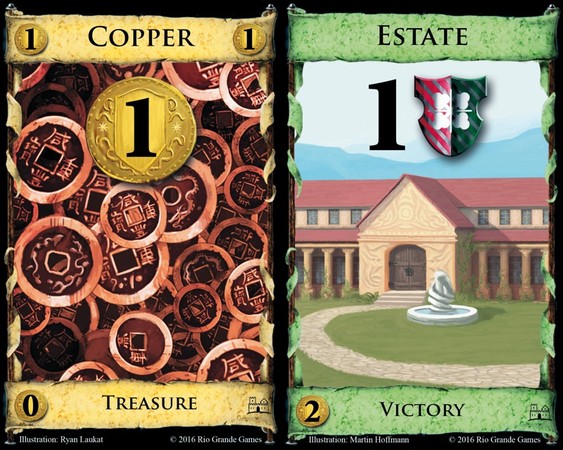
The two types of cards in a basic starting deck. Copper costs zero Coin to buy and gives you 1 Coin for the turn when played. Estate costs 2 Coin to buy, cannot be played, and gives you 1 point in final scoring.
When you play a card, you do what it says from top to bottom, stopping at a horizontal bar if there is one. When your deck is empty and you need to draw a card, you shuffle the cards you have discarded and make them your deck. When any three piles of cards are empty, or the high-scoring Province pile is empty, the game is over. Provinces and some other cards are worth points. Have more of these and you win.
Configurability
The complexity of Dominion comes from cards in the supply effectively adding more rules to the game. “Vanilla” cards are so simple that the game can be played casually with children, while more advanced cards like Procession add abstraction and crunch for seasoned boardgamers.
The set of cards picked to be in a given game are called “the Kingdom”. Kingdom design happens before the game, like deck-building does in Magic, often from a random seed. With seventeen expansions in print as of 2026, each the size of a board game in itself, there is a huge number of possible Kingdoms and possible interactions between cards, giving the game its range of target audiences and playing times, as well as its replayability.
Links
Here are my own articles on the game, in English:
- The four Fs of Kingdom design: How to prepare a game of Dominion that players will enjoy.
- Storing Dominion: Three generations of custom boxes.
External links:
- Dominion Strategy Wiki is the biggest database on the game.
- Dominion Randomizer suggests Kingdoms to try.
- There’s an online version as well as mobile apps for Android and iOS.